
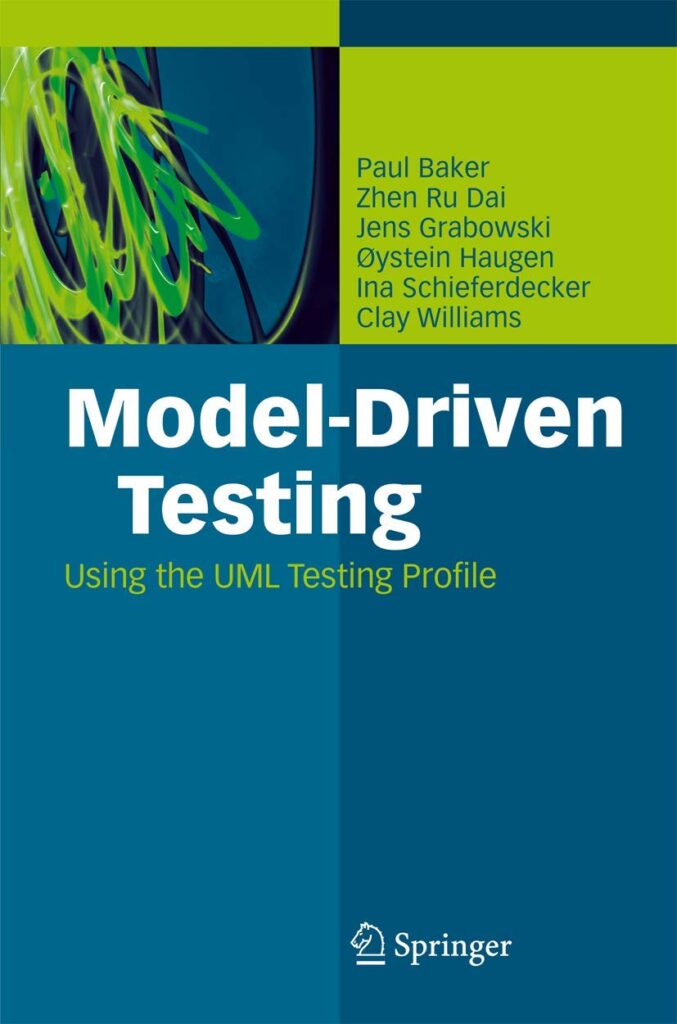

📝 Model-Driven Testing — Bringing Structure and Precision to Test Design with UML
🔍 Introduction
Model-Driven Testing (MDT) is a powerful but underused approach that connects system models directly to test cases. This book shows how to apply MDT using the UML Testing Profile (UTP) — a standard for modeling tests alongside software design.
Written by experts in testing and formal methods, the book walks through how to design, visualize, and automate tests based on behavioral system models. For testers working with complex systems, embedded software, or early test design, this book bridges modeling and test execution like few others.
📚 What You’ll Learn
- The fundamentals of Model-Driven Testing (MDT) and the UML Testing Profile
- How to use UML diagrams (e.g., sequence, activity, state) to derive test cases
- Techniques for specifying test architecture, data, behavior, and verdicts in UML
- Benefits of early test generation from design models
- How MDT improves traceability, maintainability, and coverage
✅ Who Should Read This
- Test engineers working in model-based development environments
- QA architects building test strategies for embedded or safety-critical systems
- Developers and system analysts using UML for software design
- Teams exploring early-stage testing, automation, or MBT tools
💡 My Top 3 Takeaways
- Modeling tests alongside system behavior reduces ambiguity and improves coverage.
- The UML Testing Profile standardizes how test cases can be visually and formally described.
- MDT supports early testing — long before code exists — making it great for critical systems.
📦 Where to Buy
📘 Model-Driven Testing: Using the UML Testing Profile on Amazon
Affiliate link — using it helps support this blog and promote smarter, model-driven QA strategies 🔧


